Flagship concept · source-linked · open-first

SONIC VEIL AB-01 · 音频屏障器

Stay in the crowd. Speak in a private bubble.

A near-future acoustic system for dense shared spaces: two people stay in the crowd, keep situational awareness, and still enter a perceptual privacy bubble.

Form

4 emitters · 1 sensor node · 1 edge core

Claim

Perceptual privacy bubble, not absolute silence.

Audience

Investor / media launch with a real open-source ending.

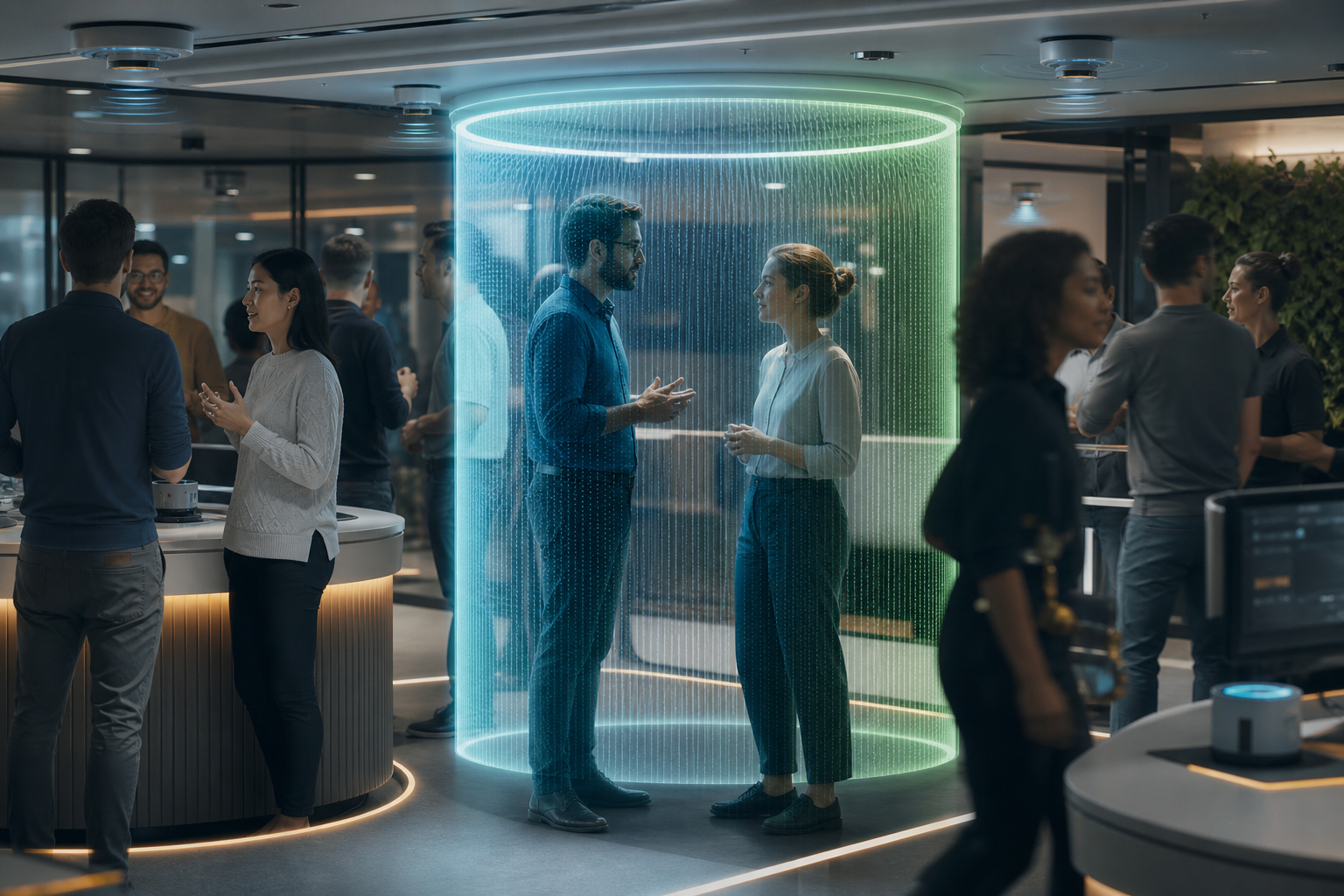
Ten people in a crowded near-future space while two people share a luminous acoustic bubble.
10 voices · one precise overlap

SONIC VEIL AB-01

The bubble is not sold as silence. It is sold as a controlled conversational envelope: clearer for the pair, less intelligible for the crowd.

Problem definition

The real ask is not silence. The real ask is selective privacy in the middle of a crowd.

A believable product for this space has to do two things at once: preserve the pair's conversation quality and degrade outside intelligibility without pretending the room stops existing.

Perceptual privacy bubble

Speech inside becomes easier to understand; speech outside becomes weaker and harder to parse.

No claim of perfect silence, zero leakage, or universal isolation in any room.

AI-assisted selective listening

The stack can privilege enrolled voices in a crowd and improve the useful signal for the pair.

No claim that acoustics alone solve the cocktail-party problem.

Safe operating envelope

Tracking loss, calibration drift, and uncertain exposure states must trigger lower output and transparent UI warnings.

No claim that futuristic visuals waive the need for exposure limits, measurement, or certification.

Mechanism stack

Four layers turn a sci-fi desire into a constrained engineering system.

The stack combines directional acoustics, field shaping, AI-assisted selective listening, and tracking-aware fail-safe control. Each layer is assigned a different confidence level on purpose.

Layer 01 · Directional ultrasonic emitters

prototype

Four ceiling or desktop nodes launch steerable ultrasonic carriers that aim toward a shared conversation volume.

The system does not claim a magical invisible wall. It claims controlled sound delivery: narrow aim, lower spill, and a stable geometric envelope around the two speakers.
Layer 02 · Active field shaping

productization

A beam-control stack continuously trims side lobes and reduces unintended audible spill outside the bubble.

This is where product discipline matters: array calibration, phase alignment, room profiling, and a lower-power idle mode when certainty drops.

Layer 03 · Target-speaker extraction

prototype

Microphone arrays capture the mixed scene, then focus the speech model on the two enrolled voices instead of every nearby talker.

This is the answer to the real problem. In a crowd, acoustics alone cannot perfectly erase interference, so selective listening has to become part of the stack.

Layer 04 · Tracking and fail-safe control

research

Head and mouth tracking update the control geometry in real time and rapidly reduce output when the system loses confidence.

Perfect privacy is not promised. A safe, measurable degradation path is. When lock quality drops, the bubble shrinks, the level falls, and the UI surfaces uncertainty.

Interactive bubble demo

A product site should show the geometry, not only talk about it.

On capable desktop browsers, the 3D scene renders the core idea: a crowd stays active, two users stay highlighted, and the system aims its useful overlap instead of painting the whole room with sound.

WebGL

Desktop prefers the 3D bubble stage when WebGL is available.

Fallback

Mobile and non-WebGL environments fall back to a static, readable geometry card.

Feasibility ladder

Separate what can be prototyped now from what still belongs to productization and research.

The site is careful about maturity. Every statement sits on one of three tracks: prototype now, mid-term productization, or far-term research.

Prototype now

  • Desktop or ceiling-mounted ultrasonic nodes with constrained seating geometry
  • Target-speaker extraction for two enrolled users
  • Tracking-aware power reduction and explicit confidence UI

Mid-term productization

  • Better room calibration and lower leakage through array optimization
  • More resilient re-lock behavior in motion and reverberation
  • Industrial acoustic safety measurement and certification workflow

Far-term research

  • Moving from constrained seating to freer crowd navigation
  • Multi-bubble orchestration in one room without unstable interference
  • Shrinking the hardware footprint toward furniture-scale or wearable adjuncts

Scenario value

The product matters only if the bubble changes real behavior in real shared spaces.

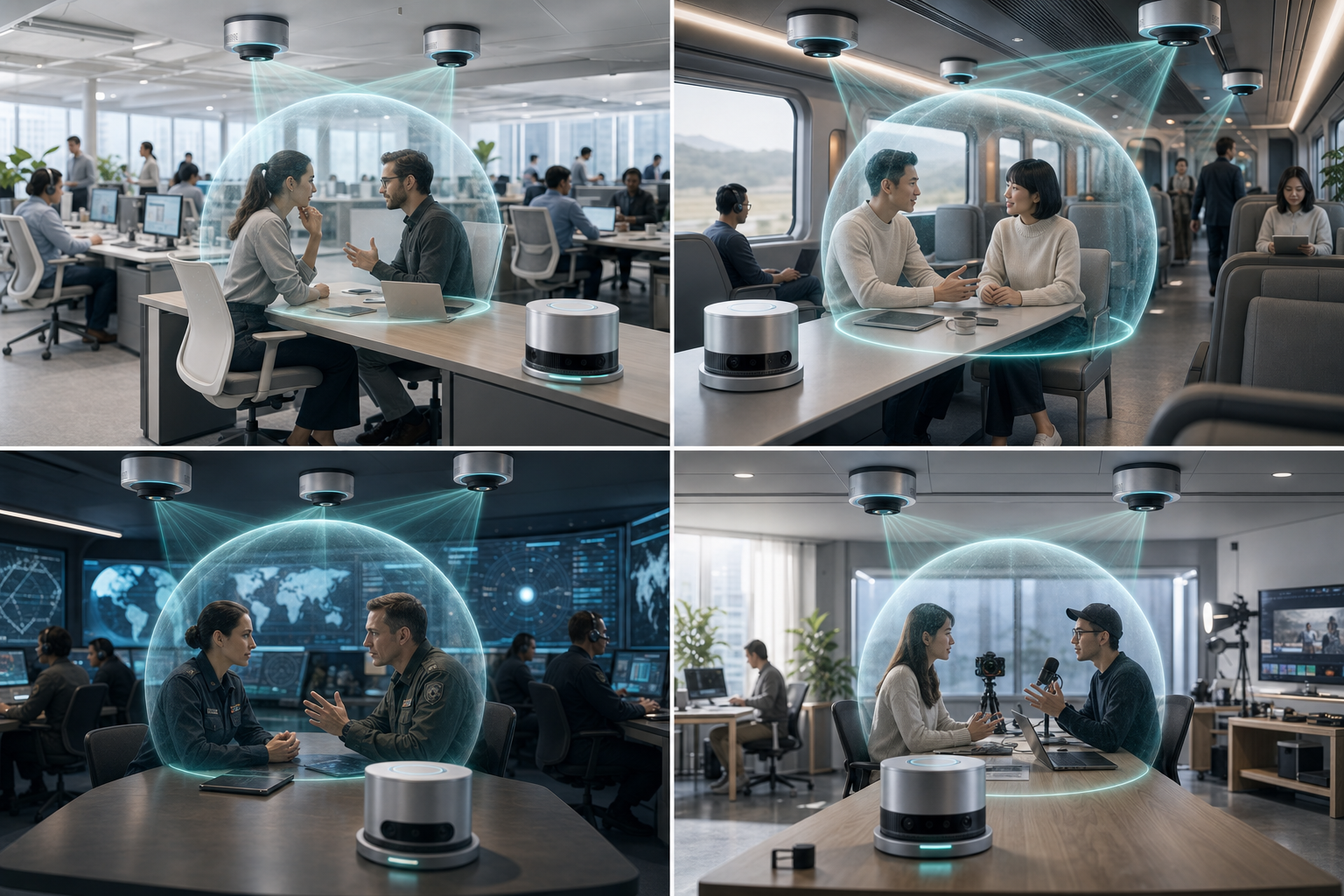
The first release story is intentionally concrete: open office, train lounge, command cell, and creator desk. Four scenes, one operating principle.
Four future scenarios using SONIC VEIL AB-01: open office, train lounge, command cell, and creator desk.

Open office

10 voices · 3 m²

Small project huddles happen inside the team floor instead of escaping to meeting rooms.

Design target: speech becomes clearer inside the bubble while outside listeners lose sentence intelligibility first.

Train lounge

Mobile cabin

Pairs can review plans, negotiate, or take sensitive calls without sealing themselves off with headphones.

Design target: faster re-lock after body sway and seat vibration.

Command cell

Dense control room

Critical operators can exchange short tactical speech while the room keeps its shared awareness.

Design target: transparent uncertainty handling and power-reduction fail-safe.

Creator desk

Studio / desktop

A solo creator can enter a review bubble with an editor while the studio remains socially open.

Design target: usable on desktop stands before a full ceiling deployment exists.

Open route

The ending is not “trust us.” The ending is a stack the world can inspect, fork, and pressure-test.

Open-source is part of the credibility story: publish the website, the notes, the control logic, the prototype hardware fixtures, and the known gaps.
siteacoustic-corebeam-controltrackingresearch-notesprototype-hardwareThe stack is designed to open-source the explainable layers first: site, notes, control logic, tracking, and prototype hardware artifacts.